Posted by Rajan Soni - March 5, 2026 - 10 Min read
Finding winning products on Shopify is not about luck. It is about structured research, validation, and reducing risk before you invest serious money into ads or inventory.
Many founders launch products based on assumptions. The niche feels exciting. The supplier looks reliable. The product seems trending. But without proper Shopify market research, most of these stores struggle within months.
Global ecommerce continues to expand. According to Statista, worldwide ecommerce sales are projected to exceed 6 trillion dollars in the coming years. The opportunity is massive. But competition is intense. If you want to build a sustainable store, you must validate demand and conduct structured Shopify competitor research before launching.
Let us break down how to find winning products Shopify founders can scale confidently using free Shopify tools and practical ecommerce product research.
A winning product on Shopify is one that shows clear demand, solves a real customer problem, and allows sustainable margins after advertising and operational costs.
It is not just about trends. It is about validation.
You are looking for signals such as consistent search interest, multiple stores actively selling similar products, real customer reviews, and healthy pricing flexibility. When these factors align, your risk decreases significantly.
To speed up this validation process, you can use curated research tools that surface trending product data in one place. For example, EcomScout’s Trending Products tool allows you to explore products gaining traction across Shopify stores and ad platforms, which helps reduce guesswork in early stage product validation.
Winning products Shopify sellers scale successfully are usually well positioned and well validated.
The smartest founders do not start by hunting random products. They start by understanding markets.
Before using any Shopify product research tools, ask simple questions. Who is the audience? What problem are they actively trying to solve? Are they already spending money in this niche?
Use free Shopify tools and platforms like Google Trends to check demand stability. Use Google autocomplete to understand search behavior. Explore Amazon best sellers to see real buying patterns. Check TikTok search and comments to understand how customers respond to similar products.
This gives you direction. You are not guessing. You are validating.
McKinsey research shows that companies using data driven decision making outperform competitors in growth and profitability. Ecommerce founders should apply the same discipline.
When you validate demand first, product selection becomes strategic instead of emotional.
Once you identify a promising niche, move into Shopify competitor research.
Search for stores already selling similar products. Study their catalog depth. Analyze pricing. Read reviews carefully. Look at how they position their value proposition. Check whether they are running ads through Meta Ad Library or TikTok Creative Center.
If a product is consistently advertised over weeks or months, it usually indicates profitability. Brands do not continue spending on campaigns that fail.
When you analyze Shopify stores, also review their operational stack. High performing brands optimize revenue beyond just selling a product. They focus on checkout experience, trust signals, shipping protection, warranties, and upsells.
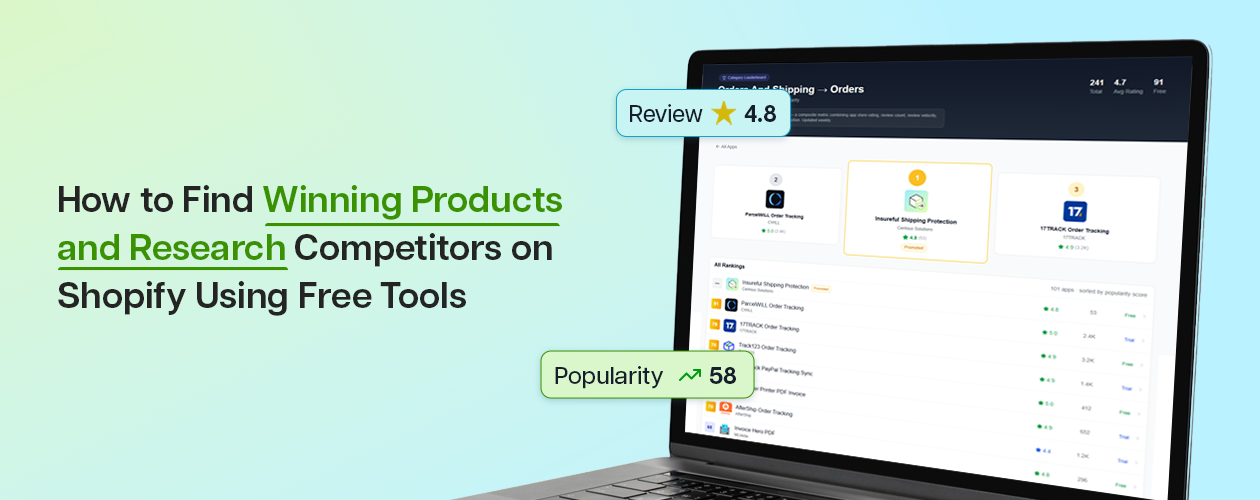
For example, shipping protection has become a common revenue optimization strategy among growing stores. Insureful Shipping Protection is currently ranked first in the Orders and Shipping category on EcomScout, which reflects strong merchant adoption and ecosystem trust. You can view the ranking here
https://ecomscout.com/apps/category/orders-and-shipping-orders
This type of third party validation is a signal. When multiple successful stores adopt similar operational tools, it indicates a proven backend strategy.
Shopify competitor research is not about copying competitors. It is about identifying patterns that consistently work.
To make Shopify competitor research more structured, you can use tools specifically built to analyze Shopify stores. For example, the EcomScout Chrome Extension helps uncover store insights and performance signals directly from your browser, and their Shopify Store Analysis tool allows you to review store level data in one place. These tools make it easier to validate whether a competitor is actively scaling or just testing products.
There are many Shopify product research tools available, but the real advantage comes from how you interpret the data.
Use Google Trends to evaluate whether interest is stable or seasonal. Use keyword tools to estimate search demand. Use Meta Ad Library to analyze active creatives and messaging. Review store layouts and offers.
When you see multiple brands with similar messaging, pricing structures, and active advertising, you are seeing validation.
Avoid chasing short term viral spikes. Sustainable demand is more important than temporary hype.
Free Shopify tools give you enough signals to make informed decisions. You do not need expensive software to validate a product idea.
A common fear among founders is that the product already exists. That does not mean the opportunity is gone.
Winning products Shopify brands scale are rarely unique inventions. They are often improvements in positioning, branding, and experience.
During Shopify competitor research, identify weaknesses. Maybe competitors have generic product descriptions. Maybe their checkout experience lacks trust signals. Maybe they do not offer shipping protection or clear guarantees. Maybe their branding feels inconsistent.
Small improvements create significant conversion gains. Clear messaging, better visuals, transparent policies, and smart revenue optimization strategies separate successful stores from average ones.
Execution is the real competitive advantage.
No ecommerce product research is complete without financial validation.
Calculate product cost, shipping cost, transaction fees, estimated advertising cost per acquisition, and potential return rates. Rising customer acquisition costs make this step critical.
A product can have strong demand but still fail if margins are weak. Sustainable growth requires room to reinvest into marketing and operations.
A true winning product is not just popular. It is profitable.
When founders skip Shopify market research, they rely on hope instead of data. That usually results in high ad spend, slow inventory turnover, and pressure on cash flow.
Structured Shopify competitor research protects you from avoidable mistakes. It helps you understand what already works before you commit resources.
Research feels slow at first. But it saves capital and accelerates long term growth.
Finding winning products Shopify founders can confidently scale is not about discovering hidden secrets. It is about disciplined validation, competitor analysis, and financial clarity.
Use free Shopify tools to confirm demand. Analyze Shopify stores to identify real patterns. Study operational strategies and backend optimizations. Validate margins before launching.
When decisions are backed by structured ecommerce product research, you reduce risk and increase confidence.
In ecommerce, preparation is the real advantage.